
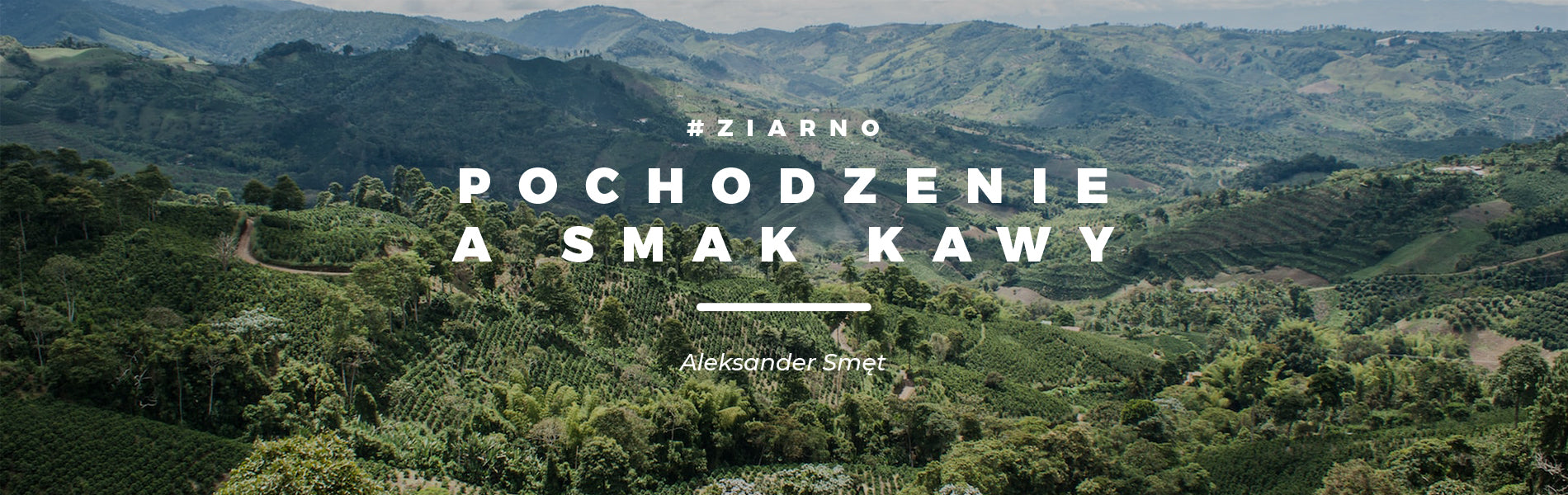
The origin of a coffee is the first thing that can tell us something about what to expect in a cup. Sometimes, looking at the available singles can be overwhelming due to the sheer number of choices. Don't worry! It's actually quite simple!
Let's think back to geography class in school and recall what a world map looks like. Coffee plants are very demanding when it comes to cultivation, but that's a topic for another post. Favorable conditions for them occur in the so-called "Coffee Belt," precisely between the Tropics of Cancer and Capricorn.
The coffee belt encompasses parts of four continents: South America, Central America (part of North America), Africa, and Asia. The basic division is based on these continents.

South America - nuts, caramel, chocolate
The most common countries appearing on South American packages are Brazil, Colombia, Peru, Bolivia, and Ecuador. The majority of South America is comprised of lowland areas up to 1,000 meters above sea level. This low altitude facilitates coffee cultivation, allowing for highly efficient tree planting and mechanical harvesting. This makes Brazil the world's largest coffee producer. High-quality South American coffee often has notes of nuts, caramel, chocolate, and a very delicate hint of red fruit. It is a "classic" among coffees.
Central America - a range of flavors
Central America is largely composed of small islands and a mainland portion. Coffee-producing countries in this part of the world include Guatemala, Honduras, Costa Rica, Nicaragua, Panama, and El Salvador. The terroir here is very diverse, which also translates into a diverse flavor of the coffees. Here, you'll find intensely chocolatey and caramel-flavored coffees from El Salvador and Honduras, sweet and fruity coffees reminiscent of red and yellow berries from Costa Rica, and floral and complex coffees from Panama. Interestingly, Panama is one of the countries where the conditions for growing coffee are suitable for even the most demanding varieties. It's here that coffees that have repeatedly appeared at the World Barista Championships over the past few years are grown, with prices reaching up to $2,000 per kilogram!
Africa - fruits and flowers
Africa is the birthplace of coffee. From there, coffee trees have spread to every other part of the world. The part of the continent where coffee grows is relatively mountainous and located high above sea level, which greatly enhances the flavor of the coffee, but unfortunately, makes its cultivation and harvesting difficult. This doesn't change the fact that African coffees are highly valued by coffee enthusiasts and frequently used in various coffee championships. Coffee-producing countries include Burundi, Ethiopia, Kenya, Congo, Tanzania, and Rwanda. The sensory profile of African coffees is primarily fruity and floral. They feature abundant citrus, currants, strawberries, tropical fruits, jasmine, and chamomile. Coffees from Ethiopia, in particular, often have a flavor reminiscent of Earl Grey or Assam tea.

Asia - growing potential
Until recently, Asia was known for cultivating Robusta, or Coffea canephora. Fortunately, more and more Asian producers are recognizing the quality of coffee and are beginning to cultivate Arabica. The main producing countries are India, Laos, Myanmar (Burma), East Timor, Vietnam, and China. Until recently, the flavor of Asian coffee was reminiscent of spices, dark chocolate, and dark caramel. We are increasingly encountering coffees that taste like cherries, sweet cherries, and strawberries, supported by a classic chocolate note.
Coffee isn't just a black, bitter liquid that wakes us up, or just burnt-black beans. It's often a sweet and fruity brew, and the dull brown beans conceal an incredible aroma. The world of coffee is vast and rich, worth delving into and exploring all its facets.
Written by: Aleksander Smęt, Roast Master LaCava

Leave a comment